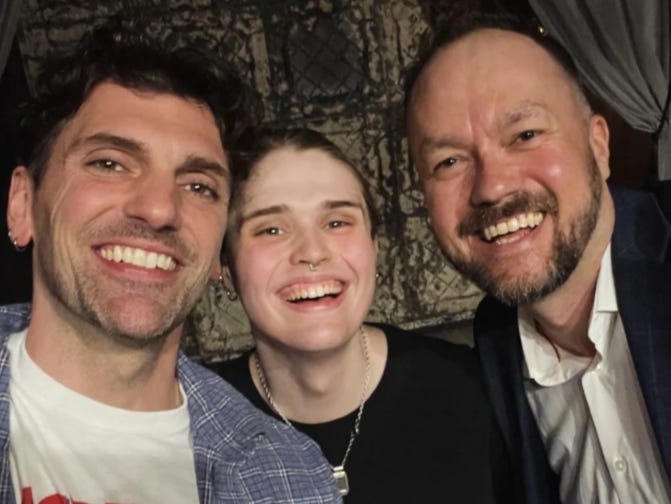
It’s been four weeks since we closed one of the most ambitious productions I’ve ever been a part of, a staging of Becky Mode’s one-man show, Fully Committed, directed by Derek Bertelsen and starring Mike Newquist. This is a crazy show for crazy people, and I fucking adore it. In summation, Fully Committed is about a struggling New York actor, Sam Callahan, who works in the reservations office of a Michelin Star restaurant. The show is jam-packed with about 40+ characters, ranging from upper-class WASPs, Manhattan socialites, stressed-out secretaries, an egotistical chef and his overworked kitchen staff, and other varieties of the most annoying class of people that anyone who has ever worked in customer service is already well-acquainted with. The catch? Every single character is voiced and embodied by a single actor in a nonstop 90-minute run.
I wasn’t originally sure if I was going to write a retrospective about this show. After all, it’s a mostly-lighthearted comedy that, in many ways, is steeped in the apolitical incuriosity of late 90s and early 2000s media. I didn’t want to force it—and I certainly didn’t want to flounder in the curtails of my Sporting Life retrospective (go read that, by the way). But there is one question that I just can’t get out of my head, and it has kept me coming back to the page: Why the hell did Becky Mode name it that?
Within the world of the play, the phrase “fully committed” is aloof doublespeak handed down to the reservations staff from the head chef, which is used to communicate to customers that there are no tables available for reservation. The chef is insistent upon it, apparently deeming the phrase “all booked up” to be too crass—which results in a great comedic moment that helps establish the chef’s character and is a rare instance of a well-executed title drop. But why is it the title of the play? Aside from this one-off joke, it’s not really that relevant to the plot and, as far as I’m aware, it’s not established industry jargon or anything. It’s an invention of the playwright, which possibly alludes to a deeper meaning.
Well, what does it mean to be “fully committed,” then? Sam certainly seems “fully committed” to his job (or rather, suffers through it due to his commitment to his acting career) and is even willing to sacrifice a monumentally important family Christmas in order to keep it. Throughout the play, we watch him run back and forth, juggling phone lines and a walkie talkie, putting out fires, scarcely able to catch his breath. That’s not just an abstraction, either. At the same time, we’re literally watching the actor portray this shift from hell, barely keeping up with the breakneck pace of the script. I said this is a crazy show for crazy people, and that’s mostly because it requires an insane amount of commitment from the performer. The entire show rests on the shoulders of one actor, so they have to be “fully committed” as well. Bam. We solved it. Subscribe for more media analysis like this. And I mean, duh. You could read this article from 2003 and that concept is offhandedly explained in the third sentence. But I want to zoom out a bit.
As I mentioned, this a very silly, mostly apolitical show (that frankly borders on being culturally problematic at times, especially in older versions of the script), but I think there’s a really important perspective we can eek out if we dig for it. Every work of art exists within the context of the material conditions within which it was created. Therefore, whether Becky Mode intended it or not, I would consider this play to be a uniquely visceral commentary on the working class condition. In case you hadn’t heard, capitalism is extractive. In the endless pursuit of better profit margins, business owners look to squeeze as much as they can out of their biggest expenditure (labor). The capitalist system asks us to be “fully committed” at all times, and it offers us next to nothing in return. It demeans and belittles us, reminding us at every opportunity that we are only worth as much as we can market our blood, sweat, and tears for. That’s where the system likes to keep us: committed to the “hustle” and thinking that we don’t deserve anything more.
There’s one line in the play, an exchange between Sam and a representative from his acting agency, that really stood out to me:
CURTIS. However. You do tend to convey a certain lack of…entitlement.
SAM. Excuse me?
CURTIS. A sense of deserving, a sense of worthiness, a sense of status, if you will.
It outlines Sam’s major arc throughout the show: he learns to accept what he deserves and, more importantly, he learns to take some of that power back. That’s an incredibly potent lesson. That’s how you survive a bullshit job, by rejecting “hustle culture” and learning to work your wage. The root of class consciousness is learning to recognize the true value of your labor. Then, once you realize you’re being robbed, it empowers you to try to take back what was always yours to begin with. By the end of the show, Sam takes a bribe, tells off his boss, leverages his resources to advance his acting career, and turns the tables on a coworker who has been taking advantage of him. Because lord knows he doesn’t get paid enough for everything we watch him do in the show—and jesus fucking christ of course he deserves to spend “the first Christmas without mom” with his family
And if we zoom out a little bit more, baby that’s how you overcome capitalism: you learn to leverage the value of your labor and you fucking take back what you deserve. Because we all deserve rights. We all deserve to have our basic needs met. We all deserve dignity. We all deserve sovereignty and self-determination. We ALL deserve to enjoy the fruits of our own fucking labor, because lord knows there’s enough to go around. The capitalist system tries to tell us that we have to “earn” those things when in reality they are unalienable. All we need is enough people to realize that truth, and to find the political will to come together and restore that universal balance.
The reason I described this play as a “visceral” commentary is, because of the nature of live performance, it forces the audience to really feel that extractive dynamic. It blurs the line between actor and character. You not only relate to Sam’s stress, but the actor’s stress as well. Because the audience can see how hard he’s working. You see him play 40+ characters, talking in a million funny voices, going full throttle for an hour and a half. It’s not just a play, it’s like a spectator sport. It’s an Olympic event in acting. What I think is important about that is how it offers an opportunity to shift the audience’s perspective on capitalist exploitation. We have all learned to embody a certain detachment from the ways we are exploited every day, but watching that happen to a deeply empathetic character (and a performer who demands our respect through the mere act of taking on such a role), it gives us permission to genuinely sit in the frustration and injustice of it all, not to mention the catharsis of him coming out on top at the end. That’s an experience you can only get from live theatre. And, if we’re lucky, maybe Sam’s arc towards self-reclamation can be a small point of inspiration for all of us.
Working on this show was certainly a source of inspiration for me. I have the utmost respect for Mike, the centerpiece of this whole production. He is endlessly talented and one of the hardest working performers I have ever met. This was a cushy gig for me. I stepped into this show for about three months and enjoyed some of the most laid-back rehearsals of my life. Meanwhile, Mike worked on this show for the better part of a year. He lived and breathed this show. Based on my conversations with him, I think this script occupied his every waking moment. He was certainly fully fucking committed—and I’m so incredibly proud of him. I know that Mike has had some really tough years recently, and that this was his return to the stage after quite a hiatus. Putting aside the script analysis and all of my intellectual waffling, what this show really represented to me was an opportunity to watch a man step into, and—in the words of the infamous Ned Finlay—”hold onto [his] own power.” And that was an incredibly special thing to bear witness to.